
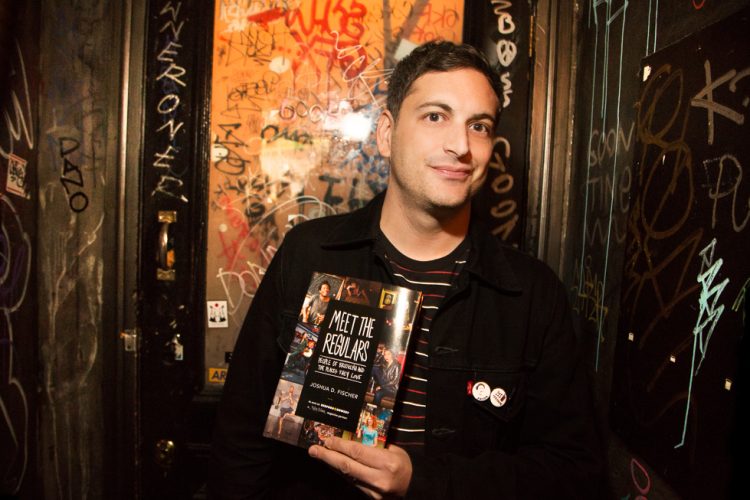

Originally an interview series on the New York magazine partner Bedford + Bowery, Meet the Regulars is a book that captures a previously unseen and entertaining portrait of the people of Brooklyn and the places they love. In talking with the regulars at bars, restaurants, and shops in the world-famous borough, author Joshua Fischer delivers deep and delightful stories presented alongside stunning snapshots from accomplished photographers including Nina Westervelt (Vogue.com, New York Times), Phil Provencio (Variety, Saturday Night Live, and CBS), and Nicole Disser (Bedford + Bowery and Brooklyn Magazine online). Meet the Regulars reveals the great power in the connections we make with the people and places where we live.
 Familiar faces include party rocker Andrew W. K. spicing things up at the Thai joint from his early days, Saturday Night Live performer Sasheer Zamata reliving a break-up at her go-to brunch spot, Radiolab host Jad Abumrad sippin’ whiskey to Black Sabbath, beloved NY1 news anchor Pat Kiernan chowing down on meatballs, actor Jessica Pimentel (Orange Is the New Black) championing her local metal bar, actor Kevin Corrigan (Goodfellas, Pineapple Express) contemplating a Guinness at his favorite Irish pub, and more.
We recently asked author Joshua D. Fischer ten questions not only about the book, but how Brooklyn has become such a hot bed for comedy over the last ten years and the importance of that fact.
What qualifies someone as a “regular”?
That’s something I wondered myself. Especially since some regulars featured in my book don’t go to their favorite spot every night, every week, or even every month. To me, anybody with a strong connection to their favorite local spot can be a regular. If the place means something to you and keeps you coming back, well, that qualifies you as a regular. Luckily, my book features an interview with Rosie Schaap, regular at Brooklyn Inn bar and author of Drinking with Men, where she shows she’s a major authority on all things regular. “We respond to a feeling of a place,” she told me. “They don’t have to be there every night…It’s the real feeling and affinity for a place that matters more.”
What is it about Brooklyn that makes it so unique and the current hotbed of creativity?
As we all know, Brooklyn is known as one of the coolest cities in the world. New York City has long attracted creatives like musicians, artists, actors, comedians and more. In recent years, when the city got too expensive, the artists took to Brooklyn and fed off the inspiring urban and ethnic environments. However, as gentrification has gained so much momentum, this dynamic is in danger. Brooklyn has a unique spirit that comes from its long-time inhabitants and the newcomers who fed off that spirit and made it their own. The question is: Is this “hotbed of creativity” sustainable? Many people who have been priced out of Brooklyn might not think so. This could be Brooklyn’s moment. And it could be a moment that’s ending. You can see and hear that in the interviews in the book.
Is it better to keep a hidden gem secret or share it with the world?
Many people feel protective of their secret spots. And that can make it a hard decision for them to share it with the world. For instance, I emailed with Andrew, the singer of beloved Brooklyn band Parquet Courts about his favorite joint in Bed-Stuy and ultimately, he told me: “I’ve got a good spot but I don’t want to blow it up. I like the charm of being anonymous there.” I appreciate that. I feel very lucky that I also met so many regulars who were willing to share their hidden gem so that people could know just what it means to them. That’s what my interviews focus on: what a place means to a person. Meet the Regulars can be seen as a guide book, but really, it’s a guide to the people of Brooklyn through the places they love.
What was the most common thread or characteristic you found that was at the root of all that these “regulars” loved?
There were a bunch of common threads and themes. So I wrote about them in essays that are also included in the book. Themes like: gentrification, a sense of home, finding community in a place where it’s easy to be alone in a crowd, finding refuge or a respite among the craziness of the city. In nearly every interview, the regular said, “It’s like that show Cheers; ‘you want to go where everybody knows your name.’” People in Brooklyn like a sense of belonging and a sense of being known. I think that’s because, again, it’s so easy to be anonymous here, and as humans, as people, we still seek connections with each other.
Talk about the importance of comedy and it’s role in Brooklyn.
Comedy is blowing up right now. This current wave keeps growing higher. Seems like every establishment has a comedy night now. Not only bars and venues, but hotels, pizza shops, barber shops, secret spaces in basements of apartments. Brooklyn and New York has a rich history of comedy and comedians. Right now, Brooklyn comedy feels like punk rock. There’s a DIY aspect to it where so many people are going up on open mics. And then it also feels like a career track. With so much “content” being made and delivered on blogs, YouTube, podcasts, and web series, seems like everybody is a comic the way that everybody once was in a band or dj’d or produced beats. I think it’s about to reach a tipping point and jump the shark. But right now, Brooklyn comedy is on fire, and it’s important because it’s our way of talking and processing the insanity of our times. Personally, it’s important to me because I’m a regular at the free weekly show Broken Comedy at Bar Matchless in Greenpoint/Williamsburg. That’s where I’ve seen some of the best names in comedy. And that’s where I get my weekly fix of laughs and love from the people at the show I’ve befriended: the hosts, the producers, the bartender, even the bouncer. Broken Comedy is very important to me.
If we took away alcohol, do you think we could have the same kind of relationships we do with venues we most frequent?
Without alcohol, we might still go to the bar or the comedy show, but we’d all be jonesing for a way to unwind. Maybe we’d all just go to the gym. Booze is a quick and easy way to let off some steam. I understand the power of the drink to bring people together. But I also recognize its dark power to tear people apart. Please drink responsibly. And please enjoy the show.
Is the word “regular” just a euphemism for obsession?
Nah. Regularness isn’t about being obsessed. It’s more about creating regular routines to help us navigate our world and our lives. I like most what public radio show Radiolab host Jad Abumrad said in the book (especially since he’s a certified genius, and he can say anything better than I could): “In a city like this, you need your patterns. Getting to work on the subway and having to collide with so much humanity, literally being pressed on both shoulders. You need to create those patterns. You need to recognize the faces on the bus every day in order for that insanity to feel manageable.”
What place/venure did you learn about that fascinated you the most but unfortunately you weren’t able to experience before it went away?
That wasn’t really the situation. However, there were several interviews with better known people that almost happened and that I wish had gone through (and there were plenty that simply wouldn’t happen at all, but, hey, it was worth a shot!). What fascinated me most was visiting venues that I wouldn’t have had a reason to go to on my own, like the black owned and operated yoga studio, the bar in the bowling alley, the hair salon for black women, the strip club (okay, maybe I would’ve gone there for a bachelor party).
Does ordinary life interrupt art and culture, vice versa, or can the two exist in one place at the same time?
It’s a symbiotic relationship. Ordinary life feeds off of culture. Culture feeds off of ordinary life. They each inform the other. We all lead ordinary lives. Culture makes our ordinary lives extraordinary.
What’s the most valuable thing you learned by putting this book together?
This book was a huge endeavor created and crafted for around three years, all told. I learned a ton about people. Personal things. Political things. And just funny and entertaining things. The great value of this book for me is that it’s really quietly a memoir. It’s a way for me to reflect on the last 13 years I’ve lived in the same spot in Brooklyn, to think on my time here and to see how it compares and connects with the experience of others. The most valuable thing to me has always been connecting with people, which is both easy and difficult for me. I can strike up a conversation. I can ask questions and learn about people. I love making friends and acquaintances. But I also struggle with the need to be left alone or just to be with only the people I’m comfortable around. It’s a delicate balance. And I learned that it’s something we all need. That’s what I learned from meeting the regulars.
You can pick up your copy of Meet The Regulars by Joshua D. Fischer right here. You’ll be glad you did.