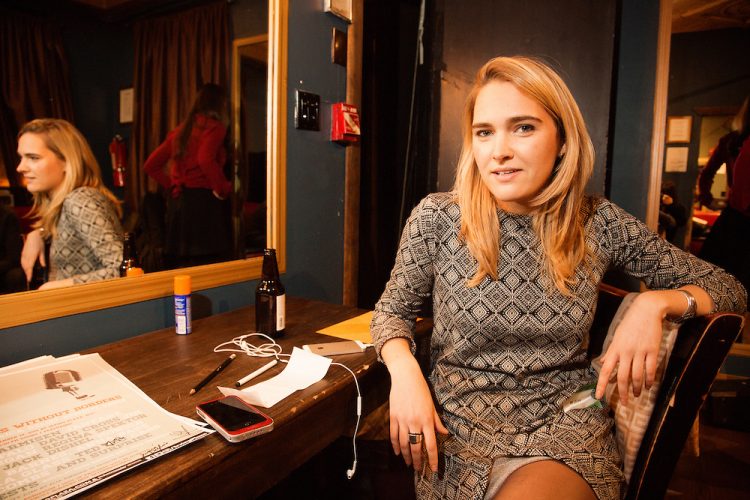

Jena Friedman is a stand-up comic who has written for Late Show with David Letterman and was a field producer at The Daily Show with Jon Stewart. Now she’s about to offer up a probing examination into the US body politic and a couple of dick jokes in her new critically acclaimed solo show, American C*nt which tapes in New York City on August 21st.
We’re spent some time with Friedman leading up to the taping to find out where exactly the name of the special originated from, what it was like starting out in Chicago, the differences between working on Letterman and The Daily Show, and what we can expect from her new special. Oh, and whether or not she likes cake or pie. Enjoy our time spent with the awesome Jena Friedman.
How are you doing Jena? Everything working out ok today since you woke up?
Yeah, haha, yes.
Do you have a checklist of stuff you have to do for the day ready to go the second you wake up?
No, I’m really bad at that. I don’t meditate or eat granola or anything. I just get up and look at my phone.
What’s the first thing you look at? Do you look at the news or social media?
I look at Twitter to see if anyone was trolling me while I was sleeping. I look to see if any misogynists posted any death threats. If not, I just start my day.
Do you purposely plant some “dirty bomb-like” tweets right before you go to bed?
Sometimes depending on how I want to feel when I wake up.
 Let’s dive right into your new special, American C*nt, which will be taped very soon. When you give your special a name like this, there’s got to be a great story behind it right?
Well, it started out as a joke. I was putting together my hour long show for the Edinburgh Fringe Festival and my friend who books The Stand, which is a venue there, she was like, “There are 3000 shows, you’re going to need a title that grabs people.” I couldn’t think of a good one so I just thought, “What’s the worst thing I could call it?” And I joked around, “What about American C*nt?” And she was like, “We have to call it that, it’s so you.” So that’s how the title came. Then I built this show around that which perfectly lent itself to a lot of the comedy I was doing at the time. It had a feminist sense alongside with being tied into the election. The show was built around the title but it became really timely as the election started to unfold. And also, if you call it that, then you’re already getting an audience that’s game for you being able to say whatever you want which I really like.
Well Jena, with everything that you do, you don’t pull any punches. You go right at it. And this just goes right along in line with that theory.
I know personally that I don’t want to make people too bummed out. I don’t like to totally preach to the choir but it is kind of nice to just call an audience that wouldn’t feel offended by what you are saying. Then that kind of frees you up to say what you’re trying to say. And not in a shock-value way. If people are going to a show with that title then they’re going in with an open mind and they’re going in primed to hear stuff from a “c*nty” perspective. So it made it a lot more fun. Even with that title, I did have some walk-outs in Edinburgh. I had people walk out 45 minutes in. There’s a cancer joke I use to have in the show that I don’t anymore. The joke was so innocuous. It was just saying how I can joke about cancer because I have a 25% chance of getting it, we all do. We all know someone who has cancer. And if you don’t know someone who has cancer, “get out there, live a little!” Well, it’s not a part of the show anymore, but the show as a whole is continually evolving. I had done a joke on AIDS, and Ebola, and abortion, and that’s what got her. It was so interesting.
That’s so surprising 45 minutes into a Jena Friedman set.
I know, I was like, “Maybe she has a small bladder.”
When you first started doing comedy, was it this easy for you to just go for it, be aggressive, and talk about whatever you wanted however you wanted? Or was it scary when you first took the leap?
Well, I started in Chicago and I actually was worse than I am now. Hahaha. I had someone, not sure if they were Bill Hicks’ old agent or something, ask me if people threw bottles at me. I still have some stuff that I’m still trying to scrape off of YouTube that hopefully never see the light of day. It was just darker. In Chicago, the audiences are segregated. You can really know if a joke is funny because you are performing to an “all Black” room, or an “all Latin” room or an “all Hipster” room. So you really get a sense of what works or not. I remember I use to joke about AIDS a lot because I was so afraid of it. I felt that joking about things you were afraid of gives you power over them. It makes you feel less alone. And I had all of these jokes, it wasn’t making fun of people with AIDS, it was making fun of my fear of it.
I remember gaining confidence to do that stuff. I was living in the gay neighborhood. And I would do open mics. Everyone else was doing Cabaret and then this c*nty little 23 year old would come in and they would let me come in and ruin everything, but they were always laughing. It was great! It gave me so much confidence. It was like, this is the demographic that was most effected by the virus and their laughing, so it’s got to be funny. So screw the hipsters who don’t understand the point I’m trying to make. You’re always going to have people half listening and not getting it.
I remember this one show I did in Chicago where a guy heckled me and yelled, “AIDS isn’t funny!” and yelled back, “How do you know that I don’t have it?” Then the whole audience shifted and got on my side. Now I didn’t get any numbers after that set, but at the same time, these are real issues that people are really dealing with. Don’t sanitize what we are saying to accommodate people who are clearly not able to deal with it. I think you can make anything funny as long as it comes from a place of humanity. I think we need to talk about things. I think pushing them out of the conversations does so much more damage than confronting them head on.
Do you think comedy is the last gateway to talk about hot button topics? Once you joke about something, it makes it ok to discuss it.
Sure. However, at the same time, I just watched Delirious and the whole first bit is just like so homophobic. And everybody is just laughing and laughing. So it’s not just about talking about things. It’s hopefully talking about it in a responsible way. And I know that doesn’t sound funny – and sometimes it’s not – it’s about trying to find a way to talk about things on the right side of history, as vague as that sounds.
To bring it back to your new special, being that you are going to film it here in America, are you just going to call it C*nt instead of American C*nt ala Cheesesteak in Philly versus Philly Cheesesteak everywhere else?
No, it’s definitely going to be called American C*nt because it’s about America. It’s almost more about America than it is about me. I mean, it’s not personal. I only have one joke that is a personal joke. The show is more outard than inward. It’s about American politics. It’s about women. It’s about women in America. I’ve probably changed about 50% of it since Edinburgh.
The way you are and the way you write hasn’t stopped you from achieving great credits like Letterman and The Daily Show, it’s a testament that you got those because of the way you are. Was there ever a time when someone said you wouldn’t be able to get great gigs if you keep going the way you were going?
I think it’s a balance for everyone on every level. Trying to make a living in our industry, there are certain sacrifices you are going to have to make. You end up making tradeoffs at different points in your career. Fortunately working for The Daily Show and seeing how much integrity Jon had in the process and in the outcome, those experiences really inspire me to head down that path. It took me a long time to make a living at doing just comedy. But I’m here now. Also, I subscribe to the power of negative thinking, which probably isn’t a good thing, but you just don’t put stock in things until they happen. Your whole career you are going to have upsets all the time. And so it’s just about how you manage them.
Now to switch gears a bit, we were able to see you tape an episode of the new show coming to Seeso called Debate Wars. I believe it was a battle between Pie and Cake. It sounds silly on paper, but it’s opportunities like this that let us get some of the best and unique comedy offerings ever. Can you fill those who weren’t in the room as to what we can expect and what that experience was like?
Well, I love Seeso, they’re producing my stand-up special. And everybody involved in Debate Wars is wonderful. I’m not a Cake fan, and it was very hard to get up there when you talk about integrity haha. I just don’t like cake. It’s not a thing that I connect with. But I’m a professional so I bit the bullet and I got up there to sell Cake. Sometime when you’re a comedian you forget, “Oh yeah, right, I’m supposed to be funny!” You know, everything’s on fire. Sometimes it’s tough to drop the Trump stuff and focus on a nice show like Debate Wars. Everyone that was on it was so great and wonderful.
 Do you find it harder or easier to write for yourself than someone else?
Oh I think it is soooo much easier to write for yourself. The Letterman job was a really great first writing job. It was challenging, at that point where he was, you didn’t know what he wanted. And then when I started working for Jon [Stewart], there was an intersection of what Jon liked and what I liked. And Jon was also really encouraging in letting us find and write about what we wanted, specifically with the field department. I did a piece with Michael Che on the OxyContin epidemic. Nothing about that was funny, but I really wanted to tell that story. It was a really important story I thought. And I was able to find the funny in it. And it was interesting and a piece that flew under the radar. And to have an actual Doctor write me to tell me that “this is a real epidemic and no one is paying attention to it, thank you so much for doing this.” That kind of silly stuff is actually really meaningful and keeps you motivated. Jon let me do that. It felt like I was writing for myself if that makes sense.
I’ve got to say, there is a lot of parody in what you do. You take something that pre-exists and put your unique twist on it to get your message across. Is that something that is deep seeded in you? Were you a big “Weird Al” Yankovic fan? Or a parody piece that influenced you as a kid?
It’s funny that you mentioned parody because a couple of years ago I realized that with the New York Times piece I did and the first thing I did right out of the gate, a satire on American Girl dolls, and now with this new film I’m working on poking fun at the rom-com genre, it’s definitely a part of what I do. However, it wasn’t that parody was something that I always appreciated. I do think it’s less parody and just finding a darker spin on things. I think it [parody] is something that lends itself to comedy easier. I think it’s a little easier, that style of comedy, but it’s also social commentary when it’s something that’s in the mainstream and if it’s recognizable to comment on it, you can say more if that makes sense. I like “Weird Al” but when I was little I was more into Edward Gorey, Roald Dahl, and John Waters, and Todd Solondz. Welcome to the Dollhouse was the first thing that I saw and said, “I LOVE THIS!” So it’s just darker.
Jena Friedman is recording her hour special American C*nt on Sunday August 21st. You can get tickets to the taping in NYC right here. And check out this old school Friedman clip of Refugee Girl Doll, the aforementioned parody.