
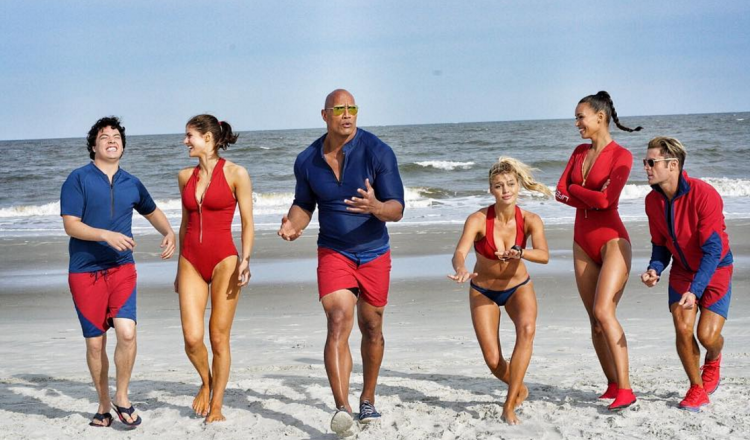

You can call me crazy, naive, or just stupid, but I was so excited for Seth Gordon’s 2017 adaptation of Baywatch. Starring the Rock — sorry, he has sufficiently eared the namesake he’s nurtured for over decade: Dwayne Johnson. Starring Dwayne Johnson and many other beautiful people, the film at first seemed like a capitalization on the former wrestler’s charisma, wrapped up in a raunchy 21st-century reboot with Zac Efron, a hip-hop soundtrack, and good improvisation. Because of all that, Baywatch seemed poised to be the perfect summer film for 2017. But opening weekend, the film took second place to the new Pirates of the Caribbean AND three-week Guardians of the Galaxy: Vol 2 holdover.
So why does a movie, which seems perfect on paper and in trailer, fail the contemporary audience it appeals to?
Let’s start with Dwayne Johnson
The fact that I’m calling him Dwayne Johnson and not “The Rock” indicates how hard this actor has hustled. His first acting offer outside WWE came on That 70’s Show, where he played a character named Rocky Johnson, a cruel amalgamation that foreshadowed his many coming years of nicknames. He leapt into Hollywood with The Scorpion King in 2002 and proved he can make a film that nets returns (he’s credited here as “The Rock”).
Johnson continued starring in both action films and the WWE until The Game Plan (2007) and Get Smart (2008). Both are family-friendly, light comedy fare that plays off of Johnson’s physique and charm — and by this time, he is credited as “Dwayne ‘The Rock’ Johnson.” Around that time he also appeared on Disney shows Cory in the House and Hannah Montana.
And then came his reckoning: 2009’s Race to Witch Mountain. The film earned just north of $67 million, on a reported $50 million budget. But it did something much greater: it earned Johnson his first credit as simply “Dwayne Johnson.” Dwayne Johnson then solidified the passing of the character he used to play by appearing on SNL as “The Rock Obama,” a glorious hulk-out of Barack. In one night, Johnson cast aside his old persona and proved that he could hold his own in mainstream comedy. There was no turning back.
Between 2009 and 2016, Johnson continued his transition phase with a balance of action films (G.I. Joe, Fast and Furious, San Andreas) and some comedy peppered in (The Other Guys, Pain & Gain). And then, in 2016, he made two moves: signing onto HBO’s Ballers, and appearing in the Kevin Hart buddy film Central Intelligence. In one year, Johnson led a comedy TV series and teamed up with the most popular name in comedy.
Johnson can juggle many types of characters: heartfelt father, tough convict, self-aware big guy, aid. His versatility as an actor, his successful career in wrestling, and his gigantic stature all contribute to Johnson starring in five films that have cleared half a billion dollars at the box office.
And other athletes are taking nothing – Johnson’s ability to pivot is one Lebron James seems to be thinking about, between 2015’s Trainwreck and the Space Jam reboot that has been teased for years. Will his credit start as “The King,” then “Lebron ‘The King’ James,” and finally “Lebron James”? Too early to call.
The Raunchy Reboot
Baywatch is nipping at the heels of many “raunchy comedy” reboots that the 21st century has popularized, shepherded by the explicit but naive sensibilities of Judd Apatow. As Apatow brought attention to actors like Jason Segel, Seth Rogen, and James Franco, those actors found filmmakers to move the genre themselves (Rogen has been busy with his film partner Evan Goldberg with movies This is the End, the controversial The Interview, and Sausage Party).
The genre was forever changed when The Hangover beat all expectations of box office success — and when it’s sequel came out, three years later, it was joined by another raunchy buddy movie, Bridesmaids. 21& Older, Project X, and Bad Santa 2 all follow in the same vein, products of the raunchy comedy precedent that directors Todd Phillips and Paul Feig have found returned box office success from.
And comedy reboots have been thriving all century, so far: Charlie’s Angels, Cheaper by the Dozen, and The Dukes of Hazzard all populated screens in the early 2000s. In 2012, writers/directors Phil Lord and Chris Miller delivered 21 Jump Street, a film that proved not only could a raunchy reboot be made well, but it could smash box office numbers (the film earned triple its budget). The success of it, and it’s sequel 22 Jump Street (a film so tongue-in cheek it would never be able to ask you out to prom), marked the success of a raunchy reboot. Cut to 2015’s Vacation and 2016’s Ghostbusters.
Baywatch is riding this wave of this ongoing reboot thirst, and the growing audience tolerance for the raunchy tone that’s been possessing the comedy genre for decades.
Zac Efron
Kudos to Zac Efron, an actor that could have been written off as just another pretty boy in an industry filled with beautiful people.
Since the third installment of High School Musical, the franchise that made Efron, he has balanced dramas (Parkland, Charlie St. Cloud) with a slew of comedies (Dirty Grandpa, That Awkward Moment, and both Neighbors films). Efron did with Neighbors what Dwayne Johnson did with Central Intelligence: he held his own next to a comedy titan (in this case, Seth Rogen).
Efron may never shake the origins of his career (there’s even a moment in Baywatch where Dwayne Johnson calls him “High School Musical”), but he has proven that he has comedic presence, even if it’s not always framed in comedies that critics are unfavorable towards.
Hip Hop Soundtrack
You know what excites me? Getting to hear Biggie Smalls in trailers. Getting to hear Childish Gambino in Jordan Peele’s Get Out, the horror film that’s rocked 2017. Hip-hop is what’s popular in the music industry, and comedies have paid attention.
Looking at comedies like 21 & Over, XX Jump Street, and Trainwreck, they all bring audiences the music they want to hear — and some really incorporate the music well. 22 Jump Street’s opening with Lil Jon’s “Turn Down for What” was the perfect use of a song that was already barely relevant, but the physical humor of the scene provided by Channing Tatum and Jonah Hill will kept it from becoming irrelevant. Watching 1980s hit Airplane, most of the references still play today. On the other end of the spectrum, Baywatch includes a dance to Desiigner’s “Panda” that already feels dated, like when Wonderful Pistachios partnered with Psy’s “Gangnam Style” two years after the song had gone viral (one year and 11 months since the song was relevant).
It’s evidence that music is a tool that can be used well for comedies or bring them to a screeching halt. And speaking of tools…
Improv Scenes
This is the biggest sin of 21st century comedies that Baywatch succumbs to.
Over the past 17 years, the talents of improvisors like Will Ferrell and filmmakers like Adam McKay have generated memorable comedies whose plot is sketched out and then the individual scenes are filled in by the actors. These are dialogue-heavy comedies that have also given actors opportunities to improvise. I remember the excitement I felt when Liam Neeson showed up in Anchorman 2, and when Lebron James went toe-to-toe with Bill Hader in Trainwreck.
However, it seems like this strategy of “throw the cameras on and hope they say something funny” makes for lazy comedies. That’s not to say all films that use improv are lazy — but the films that rely too much on the funnies coming along the way (the unfortunate reality of so many of Melissa McCarthy’s films) take away from cinematic comedic moments.
This is part of why animated films make for such consistent comedies. With the long production calendars and deliberate composition of animated films, they’re subject to much more scrutiny and deliberate action. The don’t write the script and hope something funny will come along, because they have to deliberately animate the lips delivering those lines. A live-action film doesn’t need months or years to complete one scene.
And animated films will hire comedic writers to script their jokes, the most interesting being Adaptation and Synedoche: New York’s Charlie Kaufman doing joke writing for Kung Fu Panda 2.
Edgar Wright is a director with a particularly unique visual style, one he employs in every aspect of his films: from editing and cinematography to production design.
So like anything, improv is a tool that can create good and evil, it lies in the hands of the user.
There are all tropes of the mainstream comedy genre right now: heavy improv, trendy stars and music, reboot. When the millenium began, Happy Madison, Jim Carrey, and Ben Stiller reigned supreme. Now, Sandler is exiled to Netflix, Carrey “retired” (from in front of the screen, at least) and Stiller figuring out where to go after The Secret Life of Walter Mitty and Zoolander 2.
The past 17 years has seen the creation (and passing) of franchises like The Hangover, Shrek, Garfield, and the Wayans’ Scary Movies and all subsequent spin-offs (like Epic Movie and Disaster Movie).
Now, filmmakers like The Coen Brothers are branching into TV. Melissa McCarthy is the highest-earning comedy actress of 2016, bringing in $33 million. And Mark Wahlberg is a comedic actor. All of these are testament to the genre constantly evolving and growing. And that’s where Baywatch went wrong: it didn’t do anything audiences hadn’t seen before. And nothing is worse than a joke you’ve heard twice.