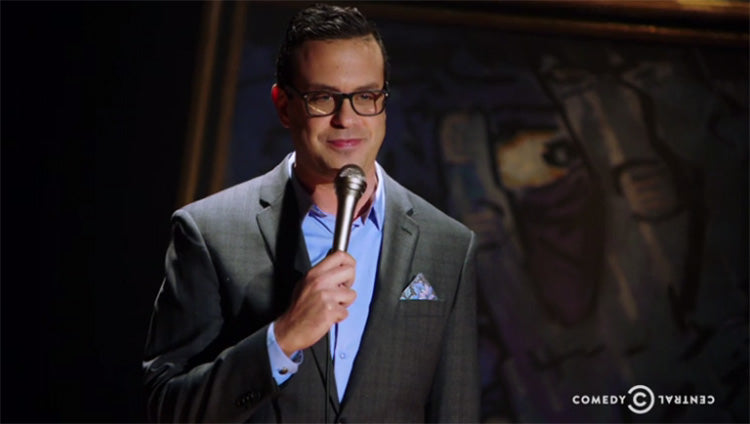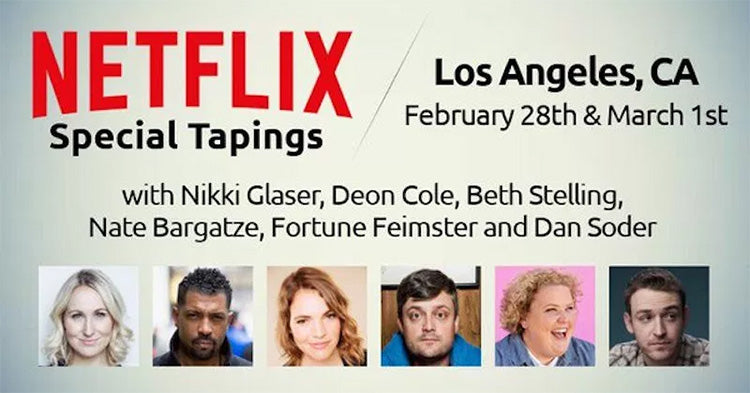
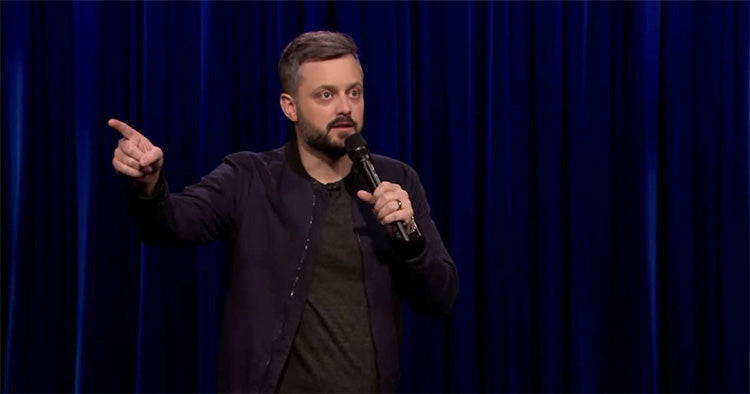

Nate Bargatze has been a working comic for over 15 years at this point, but only recently began finding himself becoming a household name. Maybe it was his half-hour spot on Netflix’s The Standups that brought him here. Maybe it’s his frequent appearances on Fallon. Or maybe (most likely) it’s his sheer talent for bring hilarity to mundanity of reality. Whatever the reason, it’s launching him to stratospheric heights, and he deserves every bit of it.
Bargatze doesn’t embellish his stories or bend the events that unfolded in them for the sake of his jokes. He just has a unique talent for observing those events in a funny way. It’s a talent that has played out in his sets time and time again; be it his joke about being challenged on what a Hammock was in Walmart or receiving milk with ice in it at a coffee shop. This strength has allowed him to appeal to varied audiences. It’s allowed him to be a clean comic without being burdened by that label and the stereotype that comes with it.
We caught up with Bargatze in Denver to talk about his writing style, a new show he’s developing and why he appeals to such a diverse audience. The conversation touched on numerous topics along the way, such as his time barking in New York and how committed he is to being a comic.
When you started comedy, you came from the South but began moving around the country: New York, Chicago, LA. How do you feel your perspective changed moving from the South into big cities?
A lot of comics can move to New York. I feel they almost like, not turn their back on the South, but I feel like they make fun of the South in a way where they’re like “Ah, I know they’re a bunch of idiots down there.” I went the opposite, like I appreciated where I was from more. I felt like you were defending the South more.
People think all those people down there are like crazy and all this and you’re like, “look there are crazy people everywhere obviously.” But I dunno, it’s a great place. It’s a regular normal place. You just want everyone to be like, “Everywhere is normal. Everywhere.”
You have to do that for New York too. If I go down South and they think New York’s crazy, you gotta be like, “Well I was there, everybody’s fine.” I took it like that. It made me appreciate where I was from more. But, I was glad to go to New York. That changed everything. To start and just learn how to become a comic in New York. I mean, I don’t think I would be remotely where I’m at.
I know in New York you were barking for the Boston for a while. Do you feel like that beginning stage of having to bark, having to bring people to shows that you don’t even know, forced you to write different so you could appeal as many people as possible or that always been the goal?
I was always clean. I guess naturally, just being clean, you’re going to appeal to more people for that reason. The good thing about barking-the great thing is you got in front of real people. A lot of comics just do open mics and you know you could be in the open mic world where you perform in front of the same people, no one cares, everyone is looking at their own jokes.
And so barking, you get in front of a different audience every night, even if it’s four people. I performed for 1 guy once. But you’re at least in front of a different person and a different group, so you’re able to try the same jokes and learn how to make those jokes good. And then, as far as the appeal, I don’t think you think like, “I’m gonna try to appeal to anyone else,” you’re just clean and relatable. The clean thing too, I never, it was never this big thing. I feel like sometimes being clean can have such a bad rap, but it’s just like, “No, that’s just how I think.”
On the topic of clean, I think one of the reasons that you don’t get labeled as just a clean comic is that you’re a little darker…
Yeah, and you know I think that’s the New York. I think it’s the going up and learning from comics that are much different: all different types of styles. So you try to do whatever you think is funny and I just happened to do it that clean way. But yeah, there is a fine line, because there’s definitely people that can be clean comics that people are not on board with at all, or people are just like “ah whatever, it’s easy.” So you have to try to find that balance.
Would you like to try dirtier stuff or do you think that’d feel forced?
It would feel forced. It just wouldn’t feel right. I always say if I had a joke that was dirty and I thought it was unbelievable, I’m not going to shut that door. I dunno, I haven’t had that. I just don’t think like that. Those jokes just don’t pop into my head, and so I don’t think I have that desire. And the way I look at it now, there’s plenty of guys doing dirty. Just like there’s plenty of guys doing political. So, it’s just kinda, “I do this thing, others do that.” If you want dirty, I’ll show you who to go to. If you want clean, if you want political, there’s guy doing each thing great.
You stray away from being political. With everything that’s going on in politics and this national climate, do you think you provide an outlet for audiences that deal with politics every day?
Yeah. I think people appreciate it. You can tell sometimes when people are like “oh it’s nice to not have people talk about it.” They get a night free of any kind of opinion. I always look at it like, I’m not a smart person. I did not go to college. Everybody in the audience is smarter than I am. Who am I to tell you what to do? I don’t pay attention. I just do my jokes, take your mind away from whatever.
And again, if someone wants those jokes, there’s plenty to go get. It’s been done a lot. It’s exhausting. I think everyone is getting exhausted. So, people need breaks. I think people are going out and looking for breaks. You can go to cities, I go to San Francisco, which is a very liberal town. But, they all come out and I think they like it. You would tend to think liberals would like the more political, but they don’t. Everyone just wants to be like, “I just want to have a day where I don’t.”
Do you think it gives you a unique lane? It feels like you’re right on the cusp of the Tom Segura-ish status, just a one hour Netflix special away. Do you feel like this is the perfect time for you?
I don’t know. It is as far as wherever I’m at as a comic. I’ve done it for 15 years now. I’ve been on the road hard for a few years. Maybe it is. It could be. If you’re getting tired of stuff. The way they picked up Rosanne and Last Man Standing. The numbers were so big.
I guess there is. There could be right now. Or at least people can appreciate it, instead of being like, “You should be talking about this stuff,” they can be like, “that’s good that you don’t.” Either people like you because of who you are, or you’re a comedian for them that’s like “That’s my break from everything else.”
Going back to that idea of defending the south, do you think there is a necessity, just from a personal standpoint, to continue to do that as you get bigger? Is it something you want to stray away from or keep as a central tenant to your comedy?
Well, I’m trying to sell a TV show. Whether that happens, I dunno. I’ve tried to sell a bunch. That’s a big topic of it, of being like, “what would you do in the show?” It’ll be a family sitcom, but there’s a question of “is it going to be like Roseanne? Is it like Last Man Standing?” And I don’t talk about that stuff a lot. I don’t know the political side of the stuff.
You can just say something on your beliefs and people loose their mind. It makes everything very scary. I was thinking about it, you know, doing a show. To sell a TV show now, you gotta have that stuff. That’s a big thing we’re talking about now. If you sell as a show, do you try to make it like that? Do you be the voice for the middle of the country… everybody besides the coasts basically. I think you would. It’s a weird balance. I don’t want to go down some route that I have to be some voice. People come to shows thinking “this is our political savior.” I’m just like, “I just want to do my dumb jokes.” The show might go nowhere.
What’s the show about?
It’s a family sitcom. It would just be that. That’s the outlet where it’s more than just my stand up. My stand-up I think will always be whatever I find funny and my stories.
Do you have a pilot written?
Yeah, we’ve had a couple. We’ve had to change and add stuff. It was interesting. Roseanne coming out was a big deal. I think it was hard for networks, people are trying to sell shows for the middle of the country, but it was hard for them to like wrap their head around it. Roseanne was like an, “Oh” moment. So many networks got it. So many people watched it. It was unbelievable. So now they’re like, “Oh…” And Last Man Standing has come back.
Has there been a lot of pressure to direct it towards those themes?
No, there hasn’t really been. Jerrod’s [Carmichael] a part of this, so his show, The Carmichael Show, it’s great. I went back and watched it. It’s very good. He was kind of the first one to… the show kinda stood out. It was different. He took topics that were tough to talk about and he would take not always the popular opinion. With Jerrod, if you know him, you know what he talks about. It’s like a mix of that and what I talk about, trying to find a balance of where it doesn’t have to be overly a platform. But I don’t want it to be this platform.
You just want it to be natural…
Yeah, I just want it to be natural and funny. Whether stuff has to be topical… I don’t know. I think when you talk about a show, I would imagine it’s one of those things where you think you want this one thing and it becomes this completely different thing. I mean look at Seinfeld. Seinfeld had different parents at the beginning. Seinfeld is different [from when the show started]. And you find the voice that works.
How many things in the show do you see changing from now?
Well first it has to go. I don’t know.
Well, do you have full creative license I guess…
Yeah, we already have. It’s me Jerrod, Ari Katcher, Dan Scheck. So we have four guys writing. We’re just writing and we’re like along in the process. They’re great, Jerrod’s great to work with. They created Carmichael, so they know what they’re doing. I’ve developed shows with a bunch of people, written with a bunch of people. It’s interesting to write with others and the different ways they write. Jerrod and them, they’re not going to make me do a show that I’m not comfortable doing. But, I gotta listen to them cause they know how to sell shows. You gotta hear what they say, say what you want to say. You have to be very honest when you’re writing a show. You never want to say later “I didn’t want this” or “I wanted that.”
Is there a difference in your mindset or approach to writing between a show vs. stand-up?
Yeah, it’s very different. When you get into, I’ve tried to sell shows almost every season. And I’ve sold scripts. Never made pilots. So, I’ve had to write pilots the past 4-5 years. When you get into that mind frame of writing a pilot, you won’t come up with any stand up material during that time because you’re thinking differently. Your thinking about your family. It’s a completely different thing and it’s very interesting to feel yourself shift. Then when you get done with it and you’re like “I need to come up with stand up.” Once that goes away… you tend to come up with stand up a little more.
Do you ever try to take a joke you’ve seen be successful and try to build a larger story off of it? Like your Dead Horse bit, it’s sort of story based, so do you find yourself make the drive itself funny?
Yeah, absolutely. Every show has had my stand up in it. I think that’s a big part of trying to sell the show. When we try to sell a show, we try to be like, “Here, we have all these stories.” So, if I did get a sitcom, I think you would see my entire act, just extremely expanded. Exactly like you said.
So, when you pitch a show, you’re essentially just doing that. Sometimes you write some stuff and maybe you don’t have your story in there. I’ve tried. I’ve had them both ways where we did and we didn’t. That’s the goal though, you have this stuff pre-in there, “Here’s a story, we can expand off this.” Some stories can be quick. Some can be long. You can build whole episodes off of one joke.
Would you like to see your stand-up career hit a peak and then move over to TV or would you like to move over immediately? What would be most comfortable?
I don’t know. It’s funny to think about time. Sometimes you’ll be like, “Alright, if we get this show and it sells, by the time it gets on the air, I’ll probably do another special. The TV show will have a couple months on, the special will come out…” You know, it’s like all this stuff you’re thinking is impossible. A. It’s ridiculous, because then nothing happens and now you’re sitting there thinking “none of that planned out.” But, if I could choose? I don’t know. Do I want the show to come out and then stand up? I don’t know. Will more people watch it then? I don’t know.
Since you’re still writing the show, if you jumped into writing after blowing up, like a Bill Burr status, versus moving in now, do you think that would have an effect on the writing or approach?
Maybe. Burr does a show. People know who you are. If I do a show, a mass majority of people wouldn’t know who I am, so they’d go in with maybe a more clean slate, being like, “I don’t know who this guy is.”
You may have a little more freedom?
Yeah, people will take it for what it is. Whereas if people have seen your stand-up, they’ll go “Well I know who you are.” I think it could be fun to do without people knowing. It’s like doing a joke in front of an audience that doesn’t know you. It happens all the time for me. Sometimes I will have people that know who I am, but when I go do shows in towns where no one knows who I am, it’s fun to do that because I get to do jokes to be like “Alright, I want to make sure these still work.”
I know you like to write on stage. When you’re writing on stage, do you find jokes change if you’re doing one off dates or when you’re doing a lot of shows back to back?
Well, you write more on the road. You write faster on the road. I’ve learned that, basically since last year, after the half hour Netflix special came out. I’ve already got it switched over to a new hour from that. We taped that like February or March of last year. It aired in July. It’s not even been a year yet.
But, writing on the road is so much faster for me then being in New York doing spots. A. It’s because I’ve been doing comedy longer. But, you have more freedom on the road. You have a longer set. What’s funny is… I’ve been building this new hour. I’ve learned that I kind of shut myself off [on stage]. I could probably use one more story, another five more minutes in my hour, but in my head I feel like I’m already done with it, so its hard to come up with stuff. Some reason in your head you’ve just blocked it.
Are you talking about towards the end of a set?
No, no anywhere. Maybe something will come. I’m planning to tape a full hour special. In my head, it’s not as easy. Sometimes I’m going months where I’ll come up with a joke every show, I got another little story, another little this… You’re adding stuff here and there. Then it’s been like a month straight of nothing. In your head, you’re tired almost. I don’t know. Sometimes when I have a joke and I have a front, and an end and it’s finished. I’ll still do it, but I don’t really add more to it. I don’t expand much outside of it. I have what it’s going to be. The rhythm feels good, it gets laughs. I like it. Even if I want to be like, “Let’s try to add some more stuff to it,” I think there’s just a block in my head that’s like, “No, no. We’re done. It’s good.”
If you’re running out of material on stage or want to play with something new, do you work off an interaction with an audience member?
No, I don’t. I’ve never done crowdwork. A lot of guys do crowdwork. You have to really do it a lot to get good at it. I just want to do my act. If something happens, it happens. I’ve definitely talked to the crowd.
You seem like such a polite, down to earth guy. Crowd work seems to involve some negativity/insulting.
It’s hard, when people get drunk and they talk, sometimes it can be really annoying and you have to say something. And you do. I don’t want to come off and just scream at something. I saw Brian Regan once, someone was sitting in the front row. This girl was falling asleep, drunk, real drunk. He like stopped the show and was like, “Hey, you should go outside and get some water real fast.” He said it real politely and nice. That was how he handled it, because he’s a nice guy. He didn’t just berate her.
Gotta say stuff, but it’s very uncomfortable. Sometimes you gotta be careful. Comics can hear everything, just where we’re at on the stage, you hear it all. Sometimes people can be talking in the front row and I can hear them and they mess up the rhythm, because all I can do is just hear them talking. And you just hear them. Then if you say something to them, people in the back don’t know they were talking. So, if you lose your mind on these people in the front, people in the back are like “This guys out of control.” And then you’re like, “No, no, no, they’re like annoying.” But they shrug and no one is really on your side at that point.
A. I don’t think I give off the energy of the type of back and forth. And B. the audience that has come out is awesome and everyone is super nice. But if I hear something I’ll just try to talk over it. And if you have to address, you have to address it. Sometimes you can make a little easy joke about it.
When it comes to your own jokes, there is a bit of self-depreciation, but a bit of a pride that comes along with it.
I don’t know if I think it’s a pride thing. I think it’s funny. A lot of people come up and talk to me about being relatable. Instead of making fun of anybody else, I’d rather just make fun of myself. I’d rather you laugh at me or with me. You either know that guy or you are that guy. I entered it from that aspect it. If you make it about you, you can make everything dumb. It doesn’t put pressure on anybody. It’s not like “What are you doing, you’re a loser.” I’ll be the loser.
If you make a blunder in your normal life and you think “I’ll make a joke out of this now,” is it therapeutic for you in a sense?
I don’t think of it as therapeutic. I don’t do therapy. I know comics think they’re doing that. I just look at it as making fun of yourself. I’m just very self-aware. I’m not smart. I say it in my act. “I’m a dumb guy, but I know I’m dumb,” which is the only smart thing I have. I’m able to take advantage of a lot of things. So many kinds of stories.
I’m very observant. I can get annoyed by things that are pointless and stupid. You need to have some annoyance. I think I come off as very laid back and easygoing. None of this stuff is going to drive me. I ordered a coffee with milk, I got milk with ice in it. I think if you’re a regular person you’re just going to move on with your life. It’s not going to become a whole thing, so [as a comic] you do have that thing that makes you lose it and go crazy and frustrated. Then you get to say it on stage.
So, I guess maybe. I don’t even think about it. It’s not like a relief… It’s a relief in the sense that the joke works. That relief is unbelievable.
You have to be around yourself a lot alone as a stand-up comedian, because you’re doing all these shows. Do you enjoy just being with yourself and noticing yourself?
It gets tiring. You’re on the road every week. It’s hard. It’s hard not to have really bad habits. You are around yourself a lot, and its better when you’re with someone. That’s why so many guys bring someone else on the road with them. You can have a friend there and go out to eat… I think you do need something, it’s nice when something happens and you have someone to talk about it with. Sometimes that’s how you come up with the best jokes, because you can get it out right then, “Oh that’s funny right?” That’s all we do, ask each other “Is that funny?”
Do you then work it out with them?
No, some guys do. I’ll try it on stage that night. I don’t ever sit down and say, “Let’s go back and forth over it.” I’ll say stuff to people. I’ve called some buddies to be like “is this funny? This thing happened.” And then they’ll be like, “that is funny.” Then you try it on stage. If you’re doing a weekend at a club, you’re doing 5 shows, so you get to do it all weekend. You’ll have somewhat of an idea if it’s going to work. You kind of know before you go on.
Do you find there are certain themes that will naturally become good comedy on stage?
You know some jokes work. All my jokes are very true. I could almost say they’re 100% true. I don’t make anything up, which has been a benefit. Not to say that makes me any better than anyone. That’s just how I do it. You have to try to be funny literally using exactly what you have. The hammock joke… Buying the hammock at Walmart, that is word for word. I’m just telling you what happened. Sometimes it works out. That’s a thing that becomes relatable too. Everyone has been in a situation where you know you’re right. Everyone’s had that with another word. Where you feel stupid, but having someone challenging it is enough to make you think “Am I wrong?” That’s something that’s very relatable to anybody. Here’s my story about it and everyone else can relate to it however they do it their own way.
Is there an awareness as you go throughout your day where you’re thinking, “Is this going to be funny?”
Yeah, you think about it. The hammock joke, I called my friend Brian Bates, who goes with me a lot on the road. And I asked him if buying a hammock came off as if I was too good. And I asked him that exactly. I can get weird in my head. I say I’m buying a hammock and all these people will look at me going “Oh, look at you.” So, then I put that in. You just start adding all of this stuff. I don’t sit and think “what’s dumb that you would do.” I’m not thinking of myself in the third person, but you do sorta train yourself to sit back… Seinfeld said it, “Comedians, we’re like an eye on the wall. We’re above watching things, even if we’re in the situation.” And that’s what your job is as a comedian: to always be aware of what’s going on.
Was there a moment where you felt like you went from trying to be a comedian to where you knew you were funny?
When you first start, you’re just doing spots. You’re in New York barking. Then you’re just in it. It’s funny, we used to always say in New York, when you start, all you’re talking about is your act. All you care about is your act. So, when you first start, you’re just oblivious. I think a lot of people I was around, you’re not even thinking about being on TV. It’s never in your world. It’s the good thing about being in New York. I was around guys that were so much better. I was around Bill Burr, Patrice O’Neil, and [Dave] Attell. All these guys that weren’t huge, Attell was probably the most known at the time. But, Burr wasn’t huge, Patrice wasn’t huge. So, you’re watching, thinking “No one even knows who these guys are, and those guys are 1000x better than I am.” At the beginning, all you’re doing is trying to be like them. You want to have a good 5 minutes or 10 minutes.
I can answer it as far as being comfortable. It’s like making money in comedy. When you first start, you don’t know if its going to work out. Comedy, you’re not promised anything. No one asked you to do this. You can’t quit. You’re chasing a dream. You’re taking a chance. Maybe it works out, maybe it doesn’t. At the beginning you have no idea if it’s going to work out. Then you will make money, but you’re still not positive. It can all fall apart. But then you hit a point, almost like when you first doing stand-up. Maybe you have an hour, maybe enough credits. I always look at it where it’s like worst case scenario, I could go to cruise ships or corporate gigs. For me, that was the first kind of relief that I ever felt in comedy. Not like those are bad gigs, it’s just being like, “I’m clean, I have an hour, I did a comedy central special.” I could do corporate gigs or cruise ships, you know, have a good life and do comedy. You’re not making it though. That’s the first like check you have. That’s a nice feeling. I’ve built at least this world up where I have an hour of material that’s at least passable. And you keep going and checking off from there.
With a family, do you have a threshold to meet that you will say “this is now what I’ll do forever” or “I need to do something else to provide for them.” Is it something you keep in mind with your career?
You gotta keep your family in mind. I still think if you want to make it, you have to go try and make it. You don’t want to wreck your family or ruin your family life. I get asked a lot, “I have a girlfriend/wife and want to keep doing comedy.” I’ve been with my wife the whole time, before I even started comedy. But at the beginning, you’re trying to make it. Not in a bad way where you want to ruin the relationship, but if she made me decide at any point, I would’ve chose comedy. I was trying to be a comedian. You have to be obsessed with this. You’re trying something that’s not promised. You have to beat people that want to do it. You have to be obsessed and be like “this is my life. This is what I’m doing.” You do have to find a balance, but at the beginning, you have to do it. If you’re going out five nights a week, there guys going seven. Most guys are going seven. Most guys are doing seven, not some guys. You have to be obsessed.
For more information about Nate Bargatze, check out it his website for tour dates and videos.