
On May 21st, Twin Peaks made its triumphant and highly anticipated return to airwaves with the first four installments of its first new season in 25 years — an event prophesied by its heroine, Laura Palmer, way back in its controversial second season.
To call Twin Peaks a cult hit would be doing the show a disservice – Twin Peaks defined the term “cult hit.” A beyond-its-years and bizarre series from experimental filmmaker David Lynch (best known, at the time, for his wildly inaccessible film Eraserhead), it’s completely insane that the show aired on major network ABC back in 1990. Set around the murder of seemingly squeaky clean small-town beauty Laura Palmer, and the complex investigation into her death, Twin Peaks starts as a lushly decorated murder mystery populated by Lynch’s signature quirky characters – but it quickly became something completely new, combining elements of traditional mysticism, mind-bending sci-fi, and intensely twisted sexual fantasy play into something that, somehow, aired on ABC.
The show’s unprecedented darkness is only part of its lingering popularity; its wild characters, namely beloved FBI agent Dale Cooper (played by Portlandia star Kyle MacLachlan) and beautiful bad girl Audrey Horne (Sherilyn Fenn) drew in plenty of fans; plus, being a Lynch production, Twin Peaks contained multitudes, plenty of hidden layers and secret signals waiting to be caught and parsed by sharp-minded viewers, which made watching it both an exercise and a self-congratulatory feat – if you understood it (or thought you did, at least), you could definitely hold it over all your friends who didn’t.
Twin Peaks as a cultural phenomenon is remembered fondly, but while it was on air, it predictably experienced plenty of drama — not just because it was taking the time slot of beloved Dynasty and viewers on the whole weren’t quite sure what to do with it, but also because, in its second season, Lynch himself departed for a bit and the show, quite frankly, went to shit. The poorly reviewed second season was the reason why star MacLachlan barely appeared in follow-up film Fire Walk With Me (and major character Donna Hayward was wordlessly recast when actress Lara Flynn Boyle refused to appear). So, while it exists as a kind of time capsule embodying a the particular artfulness of the early 90s hipster set, it was, in its time, beset with plenty of problems – which is why it was particularly interesting to hear, back in 2014, that Lynch was developing a follow-up series.
Fast-forward to right this minute, and we’ve seen the first four episodes of Twin Peaks: The Return -and boy, is there a lot going on. The series (so far) hits plenty of nostalgia points, bringing back the sometimes shockingly aged faces we knew so well (all besides Michael Ontkean, who played Twin Peaks’ sheriff but has since retired from acting); it’s also as beautifully shot as ever, costumed and decorated and lit flawlessly, bringing you right back to the way Twin Peaks felt for the first time. Lynch peppers the production with all his favorite things, like full songs performed by female-fronted bands in front of red velvet curtains (with acts like Chromatics and Au Revoir Simone subbing for original Twin Peaks queen Julee Cruise), and also a complete hour of incomprehensible symbology (episode three of The Return) that rivals Eraserhead in terms of it being a wild fever-dream full of terrifying, somehow meaningful special effects.
So far, literally none of this sounds funny, and yet Twin Peaks was always tinged with a subtle comic vibe that saved it from becoming too upsettingly dark. With characters like the Log Lady – who carried her beloved stump everywhere she went – unquestioningly welcomed into the mythos of tiny Twin Peaks, alongside quirky police department assistant Lucy (who obsessively stacked her bosses’ morning donuts by size and color), and Lynch’s own bellowing FBI Director Gordon Cole, there was plenty of comic relief.
The show earned itself a dedicated fan base of kids who would grow up to make weird art themselves, so when we got our first taste of the Twin Peaks: The Return cast last year, it was not so surprising to see so many comedians included on the list. Along with most of the original cast, we got excited to see (among many others) UCB’s Stephanie Allyne, stand-ups Jay Larson and Josh Fadem, omnipresent comic actor Brett Gelman, and Arrested Development‘s Michael Cera.
The reveal of Cera’s character in The Return‘s fourth episode set the internet on fire just as much as its incomprehensible third one did, because it was so surprising and hilarious – but certainly, it wasn’t unexpected. Knowing Lynch and the show, of course it would work in its trademark comic twists, and with last week’s fourth episode, we really began to see it.
[Minor spoiler alert from here, if you’re not caught up.]
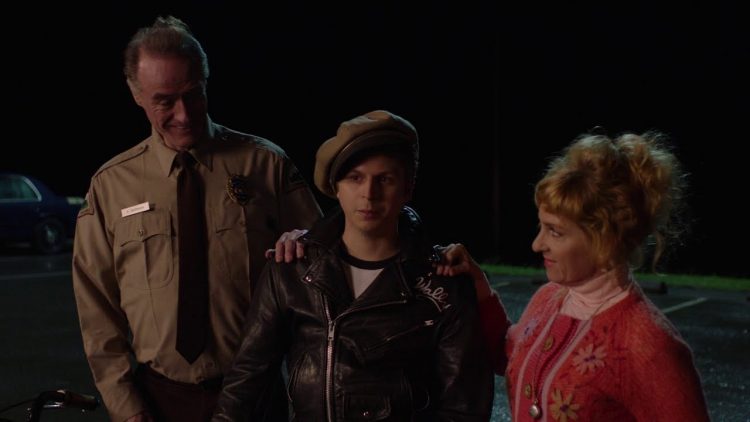
Cera flashes onto the screen dressed, it seems, as some sort of newsie — until about two seconds go by, and we realize he’s doing a purposefully perverted take on Brando, an affectation that would sour quickly on any other character but this, the young adult offspring of Twin Peaks‘ completely batty couple, Lucy and Deputy Andy. In a lisping, rambling monologue, Cera talks about his life on the road and his love for his hometown, and it’s supposed to be heart-warming – but it’s also, very much on purpose, a huge and intentionally hilarious wink to both fans, and critics who expect this kind of surface-level weirdness.
In an op-ed this week, GQ writer Scott Meslow asks, “is Twin Peaks the funniest show on TV?” And he’s got a good argument for it:
Twin Peaks has always lived in that same expansive, genre-bending tradition, where a wrenching story about a horrifying murder and the collective grief after it can always manage to squeeze a little slapstick into the margins. And there’s an extra hidden benefit to making a drama that’s this funny: It expands the entire emotional palette of your show by association. It’s not for nothing that this goofy-ass Twin Peaks episode also features the most chilling scene of the new series, as Gordon Cole and Albert Rosenfield confront the doppelgänger wearing Cooper’s mask. This scene would be scary on its own—but its power grows exponentially in the stark contrast between the laugh-inducingly childlike Dougie-Coop and this unsettling, dead-eyed pretender. It’s a special hour of television that can simultaneously be the funniest episode I’ve seen in ages and the scariest episode I’ve seen in ages—but this week, Twin Peaks managed to be both.
With 18 episodes in this latest season, we can’t wait to see where else Twin Peaks takes us.